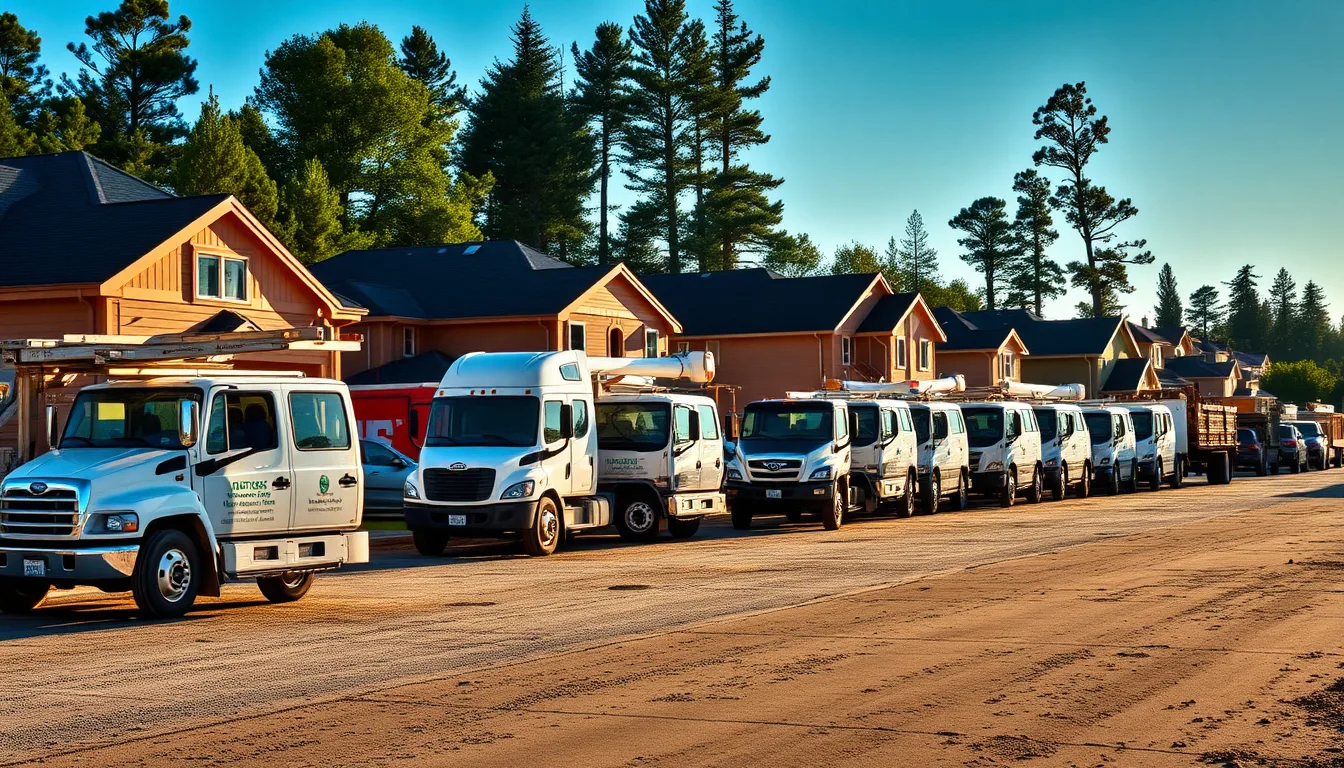
Commercial Auto Insurance — Nationwide
Commercial Auto Insurance for Homebuilder Fleets & Crew Vehicles
Liability, physical damage, and hired/non-owned auto coverage for the trucks, vans, and trailers moving your crews, materials, and equipment between lots.
What Commercial Auto Insurance Covers
Commercial auto insurance covers liability for injuries or property damage your company vehicles cause, plus physical damage coverage for the vehicles themselves, for any truck, van, or trailer titled to your business and used for company operations — hauling crews between lots, moving materials and equipment, or making supply runs.
For a homebuilder, this typically also needs to include hired and non-owned auto coverage (more on that below), since production operations rarely run on company-titled vehicles alone. A well-structured commercial auto policy for a homebuilder covers liability, collision, comprehensive, and hired/non-owned exposure together, rather than treating owned-fleet coverage as the whole picture.
Cargo and towing exposure matters too — a trailer loaded with framing tools or a truck towing equipment between active lots carries real physical-damage and liability exposure beyond the vehicle itself, and it's worth confirming your policy actually extends to towed trailers and their contents, not just the tow vehicle.
Medical payments and uninsured/underinsured motorist coverage round out a well-built commercial auto policy — protection for your own drivers if they're injured in a company vehicle, regardless of fault, and protection against the other driver in an accident carrying too little coverage (or none at all) to fully pay for your loss. Both are worth reviewing at limits that actually match your fleet's real exposure rather than accepting state-minimum defaults.
Who Needs Commercial Auto Coverage
Any homebuilder or GC with company-titled vehicles — pickup trucks, cargo vans, flatbeds, dump trucks, trailers — needs commercial auto coverage; a personal auto policy will not respond to a jobsite accident in a company-titled vehicle, full stop. But the need extends further than owned vehicles: any business that reimburses employees, supervisors, or superintendents for driving their own personal trucks on company business needs hired and non-owned auto (HNOA) coverage, even if the company doesn't title a single vehicle itself.
This makes commercial auto relevant to essentially every homebuilder and GC, regardless of fleet size — a builder running an entirely subcontracted operation with no company-titled vehicles at all can still have real HNOA exposure the moment a superintendent drives their own truck between subdivision sites on company business.
Lenders and land developers increasingly ask for proof of commercial auto coverage alongside general liability and workers' comp before releasing draws on a subdivision phase, particularly for builders running a visible fleet of branded trucks and trailers across an active site — one more reason to treat this line as a standard part of the coverage stack rather than an afterthought added only once a fleet grows large.
Fleet Considerations for Production Builders
A production builder running multiple active lots simultaneously has meaningfully more vehicle movement — and more exposure — than a single-project custom-home GC. Crews, superintendents, delivery vehicles, and equipment haulers are moving between sites constantly across an active subdivision phase, which raises both the frequency of potential incidents and the underwriting complexity of the account.
Fleet safety programs matter directly to both risk and premium at this scale: driver qualification standards, regular MVR (motor vehicle record) checks, and telematics or GPS-tracking programs are increasingly treated as a real rating factor by commercial auto carriers, not just a nice-to-have. Builders who can document an active fleet safety program — driver training, speed and idle monitoring, incident review — typically see that reflected favorably in renewal pricing over time, especially as fleet size grows across multiple active phases.
What Drives the Cost of Your Policy
Commercial auto premium is driven by the number and type of vehicles on the policy, each driver's motor vehicle record, the radius of operation (vehicles staying local to a metro area price differently than ones regularly driving long distances between markets), and cargo or towing exposure.
Vehicle type matters — a pickup truck and a dump truck or flatbed carrying heavy equipment are rated very differently given their different physical-damage and liability profiles. Driver history is one of the most heavily weighted factors of all; a fleet with several drivers carrying recent moving violations or at-fault accidents will price noticeably higher than a comparable fleet with clean MVRs, which is exactly why ongoing driver-record monitoring is worth building into your safety program rather than checking records only at hire.
Fleet size and vehicle age also factor in — a larger fleet spreads risk across more units but also represents more total exposure, and older vehicles typically carry lower physical-damage premiums (reflecting lower replacement cost) but can raise questions about maintenance and reliability that an underwriter may ask about directly. Builders adding vehicles mid-year should report new additions promptly rather than waiting for renewal, since an unreported vehicle involved in an accident can complicate a claim.
Hired & Non-Owned Auto (HNOA) — The Gap Many Builders Miss
Hired and non-owned auto coverage is the piece of a commercial auto program most homebuilders underestimate until a claim exposes the gap. "Hired" auto covers vehicles you rent or lease for business use — a rented box truck for a materials run, for example. "Non-owned" auto covers vehicles your employees own personally but use for company business, such as a superintendent driving their own truck between subdivision sites, or an office employee running a supply errand in their personal car.
Without HNOA coverage, a company can face real liability exposure when an employee causes an accident while driving their own vehicle on company business — the employee's personal auto policy may respond first, but it's often insufficient for a serious commercial claim, and the business itself can be named directly given the errand was performed on its behalf. Any homebuilder whose supervisors, superintendents, or staff regularly use personal vehicles between lots or for company errands should confirm HNOA coverage is in place, even with a small or zero-vehicle owned fleet.
Commercial Auto vs. Personal Auto
A personal auto policy is written around personal, non-business use and will typically deny or exclude a claim that arises from business use of the vehicle — a distinction insurers actively investigate after a serious accident. If a company-titled truck, or even a personal truck being used for company business, is involved in an accident, a personal policy is very likely to leave that claim entirely uncovered, leaving the business and the individual driver exposed.
This is precisely why commercial auto and HNOA coverage exist as separate, purpose-built products rather than relying on an employee's personal policy to somehow extend to company use — it generally won't, and finding that out after a serious accident is the worst possible time to learn it.
Some builders assume that because a vehicle is titled to an owner personally rather than the LLC, it stays under the personal policy even when used for company work. That assumption doesn't hold up — insurers look at how the vehicle was actually being used at the time of loss, not just whose name is on the title, and business use of a personally titled vehicle can still trigger a commercial-use exclusion on a personal policy.
Get a Commercial Auto Quote for Your Fleet
Whether you run a full fleet of company-titled trucks and trailers or rely mostly on employees using personal vehicles between lots, we'll structure a commercial auto and hired/non-owned auto program that actually matches how your crews move between active subdivision sites.
Call 844-967-5247 or email josh@contractorschoiceagency.com for a free quote. NPN #8608479. Licensed nationwide across all 50 states.
Commercial Auto FAQs
Straight answers before you apply
The core stack is general liability, workers' compensation, and builders risk on active jobs, layered with commercial auto if you run vehicles, tools & equipment coverage for your gear, and a license/permit bond required by most states — plus umbrella liability once your revenue and project scale justify higher limits.
Yes — if employees use personal vehicles for company business, such as driving between subdivision lots, you need hired and non-owned auto (HNOA) coverage. A personal auto policy generally won't respond to a claim arising from business use, and the company itself can be named in a serious accident.
Often, yes — carriers frequently offer package discounts when general liability, commercial auto, and other lines are bound together, and bundling with one agency also simplifies renewal and claims handling.
Yes — that's a core reason production builders work with a nationwide agency rather than a string of local agents; one point of contact can coordinate general liability, commercial auto, workers comp, bonds, and builders risk across every state you're actively building in.
Yes — call 844-967-5247 or email josh@contractorschoiceagency.com and we'll put together a coverage package based on your actual fleet and operation, not a generic template.
Building a subdivision? Get coverage sized for the job.
Fast quotes nationwide for production homebuilders — general liability, builders risk, workers' comp, and bonds, from one agency that speaks your trade.