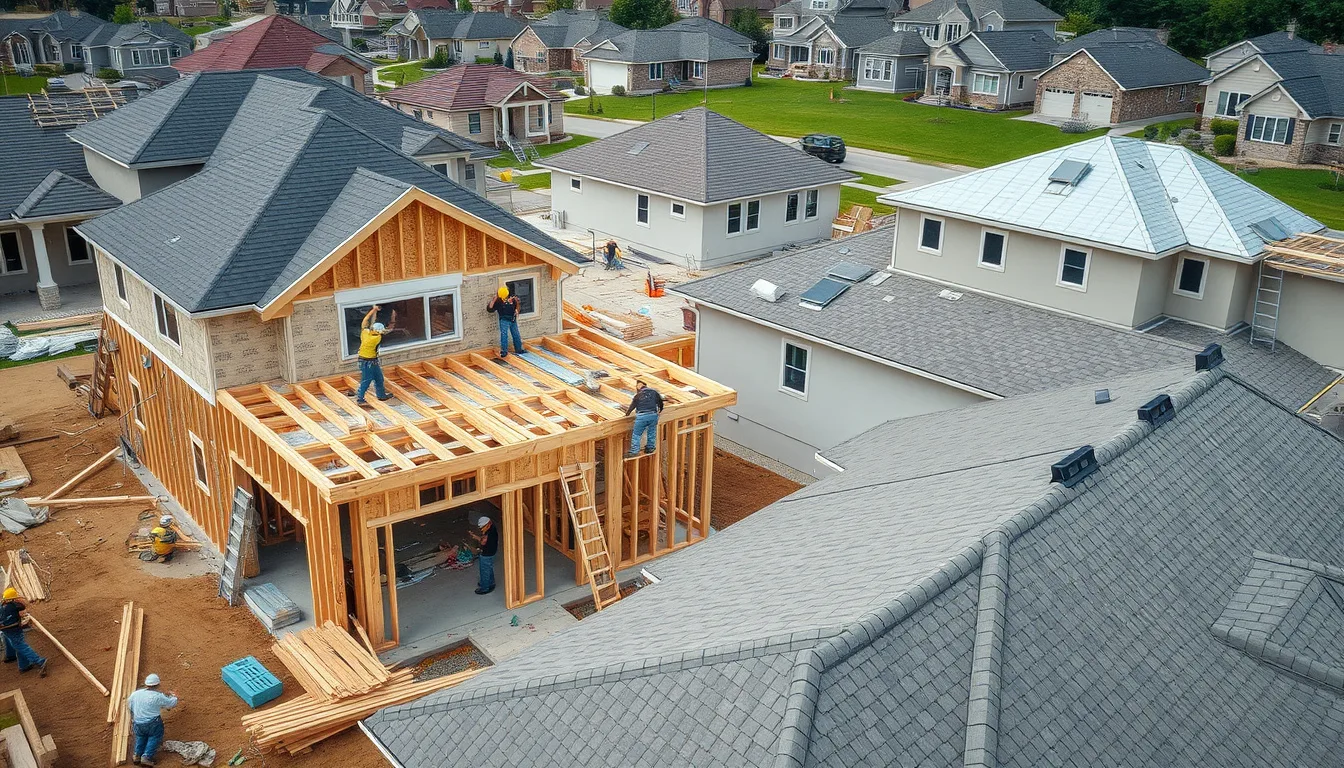
SUBCONTRACTOR DEFAULT INSURANCE
Subcontractor Default Insurance (SDI) for Large Production Homebuilders
SDI replaces per-sub performance bonds with a single policy covering the whole subcontractor base — but it's built for the largest production builders, not most of the homebuilding market, and we'll tell you plainly if it's not a fit for your operation.
What Subcontractor Default Insurance Is
Subcontractor default insurance is a single policy that covers a general contractor or production builder's financial loss when any subcontractor on a covered project defaults — walks off the job, becomes insolvent, or otherwise fails to perform. It's an alternative to requiring every individual subcontractor to carry their own performance bond on every contract.
Instead of a project owner or GC chasing bond claims separately for each sub that fails to deliver, SDI consolidates that risk into one policy held by the GC, covering the entire prequalified subcontractor roster across covered work. The mechanics are genuinely different from bonding, and worth understanding on their own terms rather than assuming it's just "a bond by another name."
SDI emerged specifically to serve very large commercial and residential general contractors managing hundreds of subcontractor relationships across simultaneous projects, where the administrative burden of tracking and enforcing individual bond requirements on every sub, every job, becomes a significant operational cost on its own. It's a product built around scale, not just risk transfer.
Who Actually Qualifies — Read This Before Anything Else
SDI is not a product most homebuilders on this site should be pricing out, and we want to be upfront about that before going any further. Carriers generally reserve SDI for general contractors and production builders with $50 million or more in annual revenue, and some carriers set the bar even higher — $150 million or more in annual subcontracted work — before the product becomes available or economically worthwhile.
If your business is below that scale, SDI isn't going to be quoted competitively, and in many cases it won't be quoted at all. That's not a sales pitch to grow into it — it's simply how the product is underwritten in the market today. If you're a mid-size production builder or a residential GC, the right tool for managing subcontractor default risk is almost certainly surety bonding on a per-sub basis, which we cover in detail on our contractor surety bonds page.
We're putting this page up front rather than burying it because we'd rather earn your trust with a straight answer than waste your time chasing a quote you can't get. If you're not sure where your business falls relative to these thresholds, call us — we'll tell you honestly, and point you toward the right coverage either way.
SDI vs. Surety Bonds — The Real Comparison
The two products solve a similar problem through very different mechanics. A surety bond is a per-subcontractor, per-project guarantee backed by a third-party surety company; if a bonded sub defaults, the surety investigates the claim independently before paying out, and the GC is one step removed from controlling that process. SDI instead puts one policy over the entire sub base, with the GC largely controlling the default determination and remedy directly rather than waiting on an outside investigation.
That difference in who controls the process — and how fast a claim resolves — is often the deciding factor for the large builders who do qualify for SDI, because a self-managed default response mid-construction can be materially faster than waiting on a surety's independent claims investigation. For builders who aren't SDI-eligible, per-sub bonding remains the standard, well-established tool, and it's a perfectly sound way to manage this exposure at any scale below SDI's eligibility floor.
There's also a coverage-scope difference worth noting: a surety bond is triggered by a defined default event tied to a specific bonded contract, while an SDI policy can be written to respond to a broader range of subcontractor performance failures across the covered project portfolio, subject to the policy's own terms and the deductible/retention the GC has selected. Neither structure is universally "better" — they're built for different operating scales and different risk-management philosophies.
How SDI Works in Practice for a Qualifying Builder
For a production builder large enough to qualify, SDI starts with prequalifying every subcontractor who'll be covered under the policy — reviewing financials, bonding capacity, and performance history before work begins, since the GC is effectively underwriting its own sub base under the policy. The builder also sets a deductible or retention level, similar to how a large GL or workers' comp program is structured.
When a sub actually defaults mid-phase, the GC-controlled process determines the default and manages the remedy — bringing in a replacement sub, completing the scope, and tracking the associated costs against the policy — generally without waiting on an outside claims investigation the way a bond claim would require. That operational speed is the core value proposition for builders running tight, multi-phase schedules where a stalled trade can hold up an entire subdivision phase.
What Drives the Cost of SDI
Premium is driven by the total value of subcontracted work covered under the policy — the larger your annual subcontracted spend, the larger the base the policy is priced against. How rigorously you prequalify subs before bringing them onto covered projects also matters materially, since a tighter prequalification process reduces the carrier's expected default frequency.
Claims and default history feed directly into renewal pricing, as does the deductible or retention level the builder chooses to carry — a higher retention lowers premium in exchange for the GC absorbing more of each default before the policy responds. SDI programs are also often structured with a retrospective premium element, where actual loss experience over the policy period can return money to the builder in a good year, unlike a bond's fixed upfront cost.
Because the premium is ultimately tied to the builder's own loss experience under a retrospective structure, the prequalification rigor mentioned above isn't just a formality — it's a direct lever on long-run cost. Builders who invest in a genuinely thorough sub-vetting process before onboarding trades tend to see that discipline reflected in more favorable premium adjustments over time.
Why Most Homebuilders Reading This Should Look at Bonds Instead
We'd rather tell you this directly than let you spend time chasing a quote that isn't going to materialize. If your business is under roughly $50 million in annual revenue, SDI is very unlikely to be available to you on competitive terms, and for most residential GCs and mid-size production builders, it isn't available at all. That's simply where the eligibility line sits in this market.
The good news is that surety bonding — requiring individual performance and payment bonds from subcontractors on larger jobs — solves the same underlying problem of subcontractor default risk, is available at essentially any builder size, and is a well-understood, well-established tool that most lenders and developers already recognize. If SDI isn't a fit for your revenue today, our contractor surety bonds page covers exactly how to structure sub-level bonding requirements that protect you without needing SDI-scale volume.
Talk to an Agent About SDI Eligibility
If your business is operating at or above the $50 million annual revenue range — or you're managing $150 million or more in annual subcontracted work — it's worth a direct conversation about whether SDI makes sense for your specific program, alongside where surety bonding still fits for the portion of your sub base that falls outside SDI's scope.
Call 844-967-5247 or email josh@contractorschoiceagency.com to talk through your eligibility and current subcontractor risk exposure. NPN #8608479. Licensed in all 50 states.
And if that conversation lands on surety bonds instead of SDI — which, statistically, it will for most builders who call — we'll set up the right bonding program directly rather than leaving you without a next step.
Subcontractor Default Insurance FAQs
Straight answers before you apply
Only if you're operating at real scale. Carriers generally reserve SDI for general contractors and production builders with $50 million or more in annual revenue, and some require $150 million or more in annual subcontracted work. Most residential GCs and mid-size production builders won't qualify — and that's genuinely fine, since surety bonds solve the same problem at any size.
A surety bond is a per-subcontractor guarantee backed by a third-party surety, which investigates and pays default claims independently. SDI is a single policy covering a GC's entire sub base, with the GC largely controlling the default determination and remedy directly — generally resolving faster, but only available to large builders.
Insurance protects your business from covered losses; a surety bond protects a third party — a project owner, a licensing board, the public — by guaranteeing you'll meet your obligations, and if a claim is paid, you're typically required to reimburse the surety. They're fundamentally different financial products even though people often shop for them together.
Standard surety bonding — requiring performance and payment bonds from individual subcontractors on larger jobs. It's available at any builder size, well-understood by lenders and developers, and solves the same core problem of subcontractor default risk. See our contractor surety bonds page for how to structure sub-level bonding requirements.
We'll have an honest conversation with you first. If you're near or above the $50M annual revenue range, call 844-967-5247 or email josh@contractorschoiceagency.com to discuss SDI eligibility. If you're below that range, we'll point you toward surety bonds, which we can quote directly.
Building a subdivision? Get coverage sized for the job.
Fast quotes nationwide for production homebuilders — general liability, builders risk, workers' comp, and bonds, from one agency that speaks your trade.